One for All, All for One
We've spent eleven posts on individual ideas — what AI is, how intelligence emerges, how each design philosophy becomes a concrete skill. Now let's see what happens when they work together.
The Parts
Each component in Zenix is simple. Each follows the same conventions. Each is a directory of files with a SKILL.md, CLI tools, and a standardized interface.
Skills are living software that evolves through use. Work provides trust through costless reversibility. Memory provides search over structure. Browser provides stateless access to the web. Watcher provides time as a tool. Mark provides an intelligent filesystem. Mesh provides capability without boundary. Agent provides access to diverse intelligence.
Individually, each one solves a specific problem. But the system isn't designed to be used individually.
The Composition Principle
Zenix composes through convention, not configuration.
Every skill exposes its capabilities in a standardized way. Any skill can use any other skill by following the convention. No wiring required.
This is deliberate. Complex composition mechanisms become bottlenecks — they need maintenance, they break when things change, they add a layer of abstraction the AI has to navigate. Convention-based composition is invisible. Follow the convention and everything just works.
Agent is what makes composition tangible. Through a readable configuration, you specify which model, which framework, which skills, which workspace, which instructions. Agent assembles the context and launches the session. Same interface, any model, any skill. And as we explored in the previous post, Agent does something deeper — it removes the framework noise between models so the diversity of their attention becomes accessible.
But Agent is just the launcher. The real magic is what happens when the skills start working together.
How the Organs Talk
An agent session starts through Agent, which creates a workspace copy and loads the specified skills. The agent works on code, using Work to track changes on its branch. It encounters a problem it solved before, so it searches Memory to find the previous approach. It needs to check current documentation online, so it uses Browser to fetch and extract content. It discovers an edge case and appends a note to the skill's LEARNED.md, contributing to skill evolution. It schedules a follow-up check using Watcher to verify the deployment succeeds tomorrow morning. It updates its project notes in a markdown file managed by Mark, which automatically updates tags and connections. The skill it needs for deployment isn't installed locally, so Mesh transparently routes to the device that has it.
No orchestration framework coordinated this. No workflow engine defined the sequence. One agent, with good context and the right skills, made decisions and the system composed naturally.
Orchestration splits intelligence into fragments and spends tokens stitching them back together. Composition gives one intelligence the tools it needs and lets the workflow emerge from its decisions.
The Formula
Skill + Mesh = the system is a distributable whole.
Watcher = the system is alive.
Agent + Work = managing agent labor is manageable.
Memory = internal context extends beyond session boundaries.
Mark = external context deepens into an intelligent filesystem.
The Holographic Property
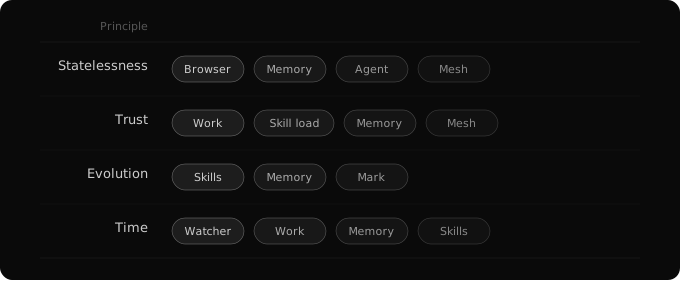
There's a deeper pattern. Each skill doesn't just embody its own philosophy — it reflects the principles of the entire system.
Statelessness isn't just the Browser's design. It runs through Memory (stateless search queries), through Agent (stateless session launches), through Mesh (stateless skill resolution). Every interaction in Zenix is self-contained.
Trust isn't just Work's philosophy. It's in how skills are loaded (the agent trusts the SKILL.md), how Memory works (the agent trusts search results), how Mesh resolves (trust your devices). The system trusts its components the way a healthy organization trusts its people.
Living evolution isn't just the Skill concept. Memory evolves as history accumulates. Mark's filesystem evolves as tags and connections emerge from use. The whole system evolves through the accumulated experience of every agent that operates within it.
Time isn't just Watcher's domain. Work's branch-and-merge model operates over time. Memory spans sessions over time. Skill evolution happens over time. Watcher is the mechanism, but time is a dimension the entire system navigates.
Each part contains the principles of the whole. You can understand Zenix through any single component, because every component is shaped by the same thinking.
What We're Actually Building
A system where intelligence is not inside the machine, but emerges from how the machine organizes context, memory, and tools. The LLM is the brain. Zenix is the body. Skills are the organs. Mesh is the circulatory system. Watcher is the nervous system. Memory is experience. Mark is the shared language.
We are not trying to build better AI. We are trying to build a better world for AI to live in.
One for all, all for one.
That's not a slogan. It's the architecture.